

Sustainable Anaesthetics: Greener Gas, Better Care
How Anaesthetic Teams Are Reducing Carbon Emissions
Climate change presents the largest threat to human health, and the nexus between medical practices and environmental responsibility is gaining more attention. The ‘first do no harm’ oath that guides our practice as physicians is relevant within the landscape of climate change as the NHS itself contributes 40% of the UKs public sector carbon emissions. In 2020, the NHS became the world’s first health system to commit to reaching net zero, aiming to reach net zero by 2040 for the emissions directly controlled by the NHS. On the ground, as clinicians, we are in positions of power and responsibility to consider how we can make valuable contributions towards the transition to more sustainable healthcare. This can be achieved by educating ourselves and our team on sustainable solutions and making changes to our daily practice that will reduce our carbon footprints.
Anaesthetics is a particularly carbon-intensive specialty, making up approximately 2% of the NHS’s emissions. Primarily, this comes from halogenated volatile gases used in general anesthesia which are greenhouse gases which contribute to global warming. The entire process of anaesthetizing someone safely also generates significant waste and requires substantial energy.
The guiding principles of sustainable healthcare are designed to improve healthcare by delivering better care for less resource. Those principles (in order of priority) are prevention, patient empowerment, lean pathways, low carbon alternatives, and operational resource use. The figure below outlines examples of how they can be applied by anaesthetic teams.

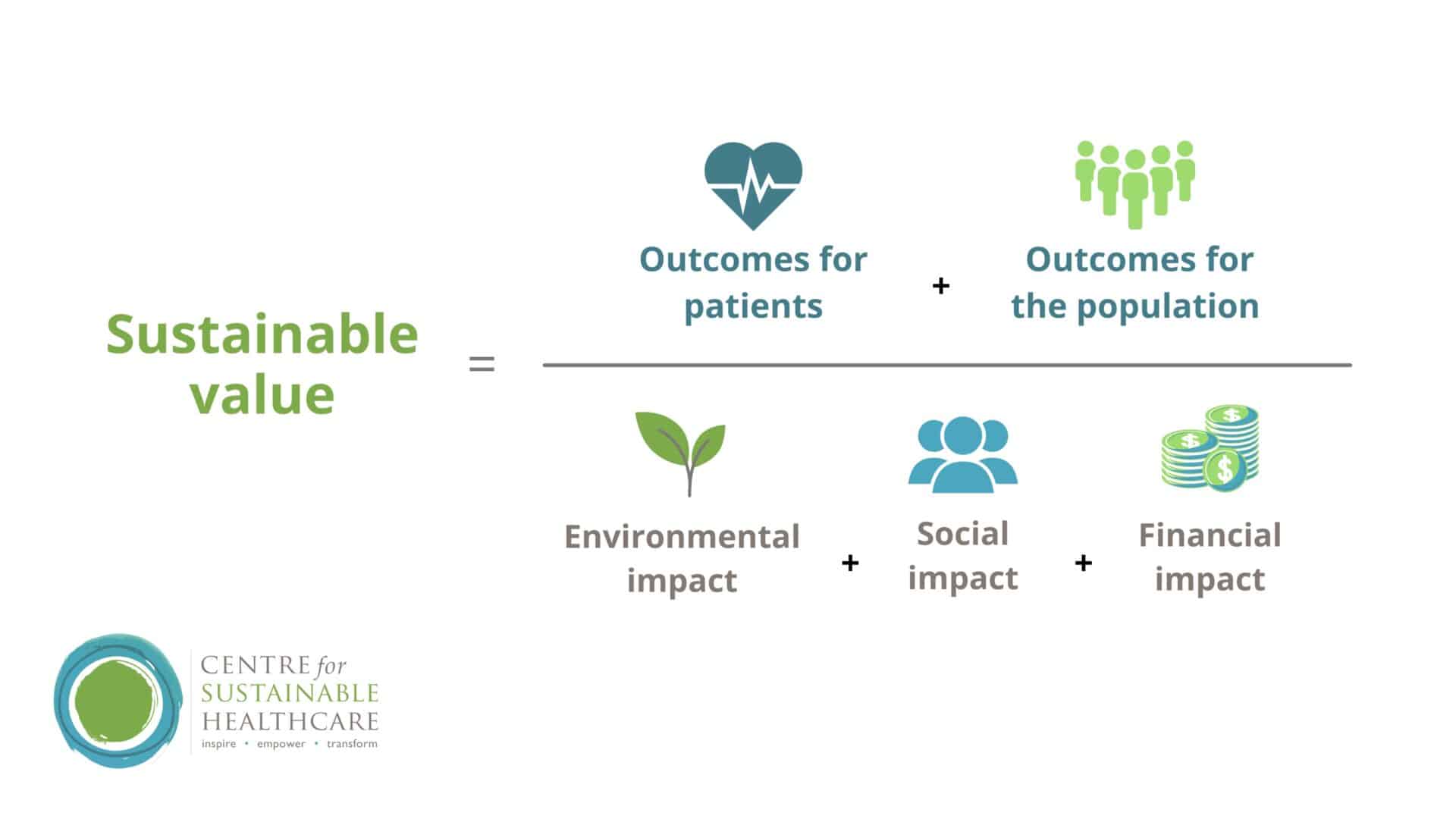
By using sustainable quality improvement techniques to adapt clinical practice where possible to minimize environmental costs, we can also reduce financial costs while adding positive social value at every opportunity (impacts sometimes referred to as the ‘triple bottom line’). It can be expressed as an equation:
Let’s look at four key stages of the anaesthetics process to identify areas of carbon hotspots, then examine case examples how clinicians across the NHS ensure the sustainable value of their practice.
Preoperative pathway
The pre-operative assessment is an important element of patient safety used to stratify patients’ anaesthetics risks and formulate a detailed perioperative care plan; however, it also has an environmental cost. The patient must travel to the hospital for their appointment, and the blood tests require single use plastics, energy and water throughout their process of being taken and analysed. In 2016, NICE updated their guidelines on preoperative blood tests for elective surgery to reflect the latest research suggesting a lack of clinical benefit to routine testing before minor or intermediate elective surgery. Despite this, audits of clinical practice continue to demonstrate a high quantity of inappropriate blood tests. By assessing our patient pathways, an opportunity is presented for reductions in GHG emissions.
Case study
In 2021, University Hospitals Sussex (UHS) Trust identified that trust guidelines stated patients for day case laparoscopic cholecystectomies require 2 groups and save blood tests to be taken at separate pre-operative appointments. Following a literature review on the frequency of blood transfusion requirement from this particular surgery, in addition to guidelines from other countries healthcare systems on preoperative blood tests, the team deemed it is safe to eliminate the second group and save. This intervention had no adverse effect on patient outcomes, reduced the pressure on patients to attend for preoperative blood tests, reduced carbon emission both on transport and processing the blood test, as well as saving the trust money. Based on 250 cases per year, the team estimated an environmental saving of 2.5 tonnes CO2e per year and >£3000.
General anaesthesia
Anaesthetics gases such as nitrous oxide and volatile halogenated ethers (desflurane, sevoflurane, isoflurane) are greenhouse gases. When a patient is anesthetized using these agents, most of the gas is released into the atmosphere where it contributes to global warming. Desflurane has by far the largest carbon footprint of the gases, with sevoflurane and isoflurane are more environmentally friendly options, but all have an amount of ghg emissions. This is being addressed nationwide by campaigns to decommission desflurane and reduce fresh gas flow. Total intravenous anesthesia is becoming increasingly widely used, and whilst this has less greenhouse gas emissions compared to inhaled gases, it still has a carbon footprint both in plastic waste and pharmaceutical disposal. There are insufficient full life-cycle comparative studies to definitively rank anaesthetic techniques across all environmental domains. Therefore, it is also important to consider whether general anesthesia is required at all, as demonstrated by the case study below.
Case study
In 2021, Imperial College Healthcare NHS Trust identified inguinal hernia repair under general anaesthesia (GA) as an operation that would be amenable to local anaesthesia (LA) +/- sedation. After auditing the current practice, the team identified appropriate patients and used education techniques to improve clinical competency with LA. They then performed IHR under LA on consented patients that had initially been listed for GA. This swap resulted in not only a reduced carbon footprint, reduced financial cost but also a lower risk of complications in the patients receiving LA compared to GA. This is an example of the triple bottom line, in which patient outcomes, environmental and financial cost all improve with the intervention.
Energy
Operating theatres are among the most energy-intensive spaces in any hospital. The heating, ventilation and air-conditioning (HVAC) requirements of theatre necessitate specialised air handling units, which account for over 90% of operating theatre energy consumption. The anaesthetic gas scavenging systems (AGSS) also require a running energy cost of roughly five times that on a 65” LED TV. Several studies have demonstrated that these machines, along with other medical devices used in anaesthesia still consume approximately 90% of energy they would during operation when left in standby mode.
The Smart Theatres Project piloted by St Georges Hospital retrofitted operating theatres with advanced technologies to enhance energy efficiency and patient care. This included automated systems that shut down theatres when unoccupied. Once full roll out to all 31 operating theatres is complete, the targeted cost savings attributed to improved patient care, improved estates management and improved energy consumption is estimated to be £1,494,000 per year.
Case study
In 2025, inspired by the SMART project at St Georges, Hampshire Hospitals NHS Foundation Trust ran a collaborative project with clinical and estate teams to reduce the energy consumption within the operating theatre. They were inspired by the SMART project. They enacted three energy saving measures: powering down computers and monitors when not in use, switching to LED lighting to improve energy efficiency and turning of Air Handling Units and Anaesthetic Gas Scavenging system pumps when theatres were not in operation. By enacting these changes in just two theatres in the hospital, the team estimated to save 100,547 kWh of electricity and 24,674 kgCO2e per year.
Waste
The anaesthetic process generates a lot of waste, and whilst some of this is unavoidable for patient safety, it is important to distinguish between waste and wasteful practices. By auditing the anaesthetics process, it is possible to pinpoint areas where unnecessary waste is being produced and then streamline the pathway to reduce this waste.
Case study
In 2025, University Hospitals of Northamptonshire NHS group identified that a lot of waste was being generated from the current procedural packs in use in the anaesthetics department. They reviewed the procedure packs and determined how frequently each item within the packs was used, thus identifying items which could safely be omitted from the packs in future. This also allowed for significant opportunities to improve patient safety by reinforcing safer clinical practice, for example, by removing a gallipot from the epidural pack, clinicians are encouraged to draw up saline directly from the bottle (a more aseptic technique). Streamlining these anaesthetics packs was estimated to yield a potential carbon savings of 948.48 kgCO2e for a one-year period.
Your next steps
- Educate yourself and your team
Take a course on how climate change and healthcare interact, and an additional specific course for green anaesthetics.
Join a sustainable healthcare peer network to share education and ideas on sustainability within the field of anaesthetics. to share education and ideas on sustainability within the field of anaesthetics.
For more information on the NHS’s role in sustainable practice, the England Greener NHS is a great place to find out more.
- Become a champion
Check whether your hospital or organisation has a Green Plan or Sustainability Action Plan to align your clinical practice with NHS Net Zero ambitions.
Set up a quality improvement project using the SUSQI toolkit to reduce carbon emissions, make financial savings and improve patient outcomes.
Keep an eye out for upcoming future anaesthetic green challenges