
Sustainability in Quality Improvement (SusQI) is an approach to improving healthcare in a holistic way. It provides a practical means by which healthcare staff can take action in their professional roles and measure the impact.
Why is SusQI needed?
Planning for sustainability is so fundamental to health and to the ability of health services to continue providing care, that sustainability should be considered an aspect of quality in healthcare. Moreover, bringing together sustainability with healthcare improvement unlocks opportunities for patient benefit.
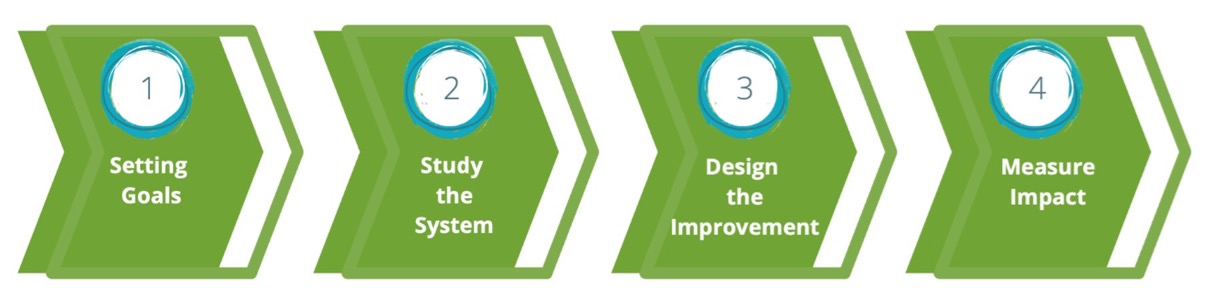
The SusQI Framework
The overall goal of incorporating sustainability into quality improvement is to maximise sustainable value. This means to deliver the best possible health outcomes with minimum financial, environmental and social resources, while adding positive social value at every opportunity. SusQI embeds The Principles of Sustainable Healthcare: prevention, patient empowerment and self-care, lean clinical pathways, low-carbon alternatives and sustainable operational resource use.
The SusQI framework outlines four stages of any improvement process at which sustainability should be considered and actively implemented.
This easy to implement step-by-step guide for each stage of the process can be used in any healthcare setting.
Setting goals
The first part of the SusQI framework involves defining the problem and goal of the process. During this, consideration should be given to environmental and social impacts and a culture of resource stewardship.
Studying the system
Before thinking about improvements, it is vital to understand the current system. This can be done through value process maps where environmental, social, and financial resource use is identified. Wasteful or low value steps and carbon hotspots within a pathway or process are made visible and can be addressed through improvement projects.
Designing the improvement
When considering changes to address a problem, the principles of sustainable healthcare; prevention, patient empowerment and self-care, lean pathways, low carbon alternatives and sustainable operational resource use should be considered for application.
Measuring impact
As with all QI, a clear set of measures is essential for assessing changes in improvement. SusQI is unique in the consideration of a set of measures based on the concept of sustainable value. Outcomes are considered and measured for patient and/or population health as in all QI, with an additional focus on environmental impact measured through a reduction in activity/resources used or through a carbon emissions assessment. Social impacts for patients, staff and carers should also be measured in addition to assessing financial costs/savings.
How is SusQI being applied?
The SusQI framework was developed by the Centre for Sustainable Healthcare with partners, including the Royal College of Physicians, and has been shown in research to engage and motivate learners to participate in sustainable healthcare and in quality improvement. At CSH we use SusQI in our teaching and in our Green Team Competitions and Green Specialty Challenges. We support organisations to embed sustainability into their QI education and practice through our SusQI Academy and Beacon Site programme. Our resource library includes over 200 case studies of SusQI projects.
CSH is working to evaluate the impact of SusQI in practice and improve the impact of our programmes. The Nuffield Department of Primary Health Sciences at the University of Oxford conducted a qualitative evaluation of the 2022 Green Team Competitions, finding significant environmental and financial savings – the seven participating sites projected over 7.1 million kgCO2e in reduced carbon emissions and over £780,000 in financial savings – with a positive effect on staff morale. The study identified an opportunity to maximise the benefits of the programme through strategic development in the post-competition period.
Key references
- Mortimer F, Isherwood J, Wilkinson A, Vaux E. Sustainability in Quality Improvement, Redefining Value. Future Healthcare Journal, 2018 Vol.5(2):88-93 https://doi.org/10.7861/futurehosp.5-2-88
- Mortimer F, Isherwood J, Pearce M, Kenward C, Vaux E. Sustainability in quality improvement: measuring impact. Future Healthcare Journal, 2018 Vol.5(2):94-97. https://doi.org/10.7861/futurehosp.5-2-94
Find out more about SusQI, the evidence and resources available at https://www.susqi.org/