‹ Go back
Long Read: Spotlight on Sustainable Kidney Care
Why does kidney care need system-level decarbonisation?
Kidney care is one of the most carbon-intensive medical specialties, contributing disproportionately to the overall carbon footprint of healthcare. This is the result of several factors, including dialysis resource intensity, high volumes of waste, and significant greenhouse gas emissions resulting from treatments, transport, and manufacturing.
As kidney care drives climate change, in turn, climate change leads to a rise in kidney-related illnesses, with one meta-analysis calculating that every 1°C rise in temperature leads to a 1% increase in kidney-related morbidities. As such, there exists a vicious cycle which can only be remedied by decarbonisation of the kidney care system at large. Through partnership in three long-term kidney care projects spanning the UK and EU, CSH is taking systematic action toward this goal.
CSH’s approach to transforming kidney care
Through a series of mutually reinforcing outputs, CSH’s kidney care projects aim to develop and embed sustainable practice at all levels of the system while maintaining safety and satisfaction for patients and staff, and delivering cost savings.
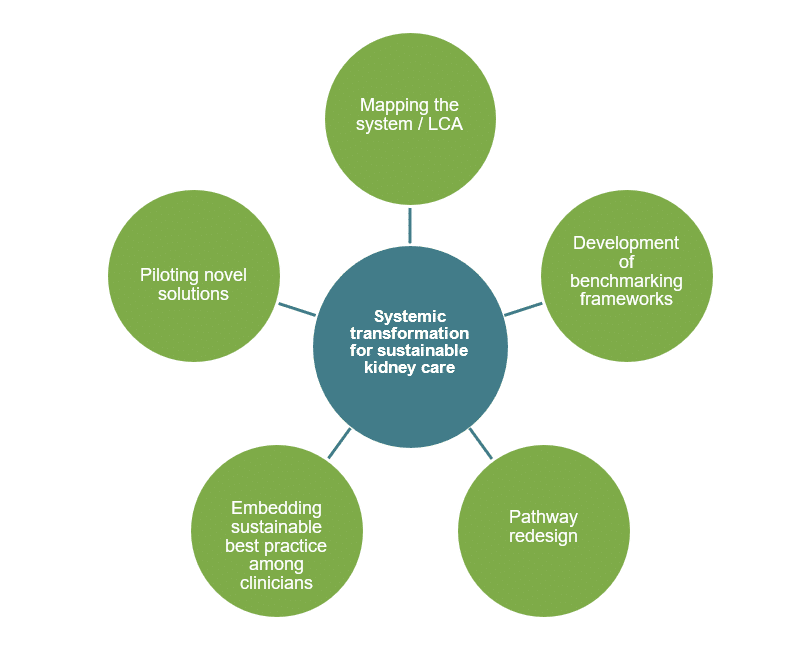
“In 2025, I am proud that CSH projects have contributed to big a step forwards towards sustainable kidney care, moving from theory to action. The UK project, ‘Implementing Best Practice,’ has created a national benchmarking tool and toolkit to track and drive progress on 13 sustainable changes across UK kidney centres. The Living Kidney Donor project has shown how local teams can be supported to streamline their own care pathways, minimising travel and respecting donors’ time; while KitNewCare is demonstrating how transformation can be achieved across Europe.”
– Frances Mortimer, CSH Medical Director

Building the benchmarking foundations: The Sustainable Kidney Care Project
The Sustainable Kidney Care Project is a two-phase UK project focussing on lowering the carbon footprint of kidney care while conserving water and reducing costs. It seeks to embed sustainability throughout the kidney care pathway and empower clinicians through training and leadership development.
Phase one: Implementing best practice
Phase one of the project, delivered in partnership with UKKA and Health Innovation North-East and North Cumbria with support from Greener NHS, saw the development and implementation of a robust, UK-wide benchmarking framework for sustainable kidney care best practice. Hosted by the UK Renal Registry, the benchmarking survey allows kidney centres to record data on 10-15 evidence-based interventions for sustainable care. Centres can then use the framework to track and measure their progress, supporting the adoption of sustainable best practices across renal services.
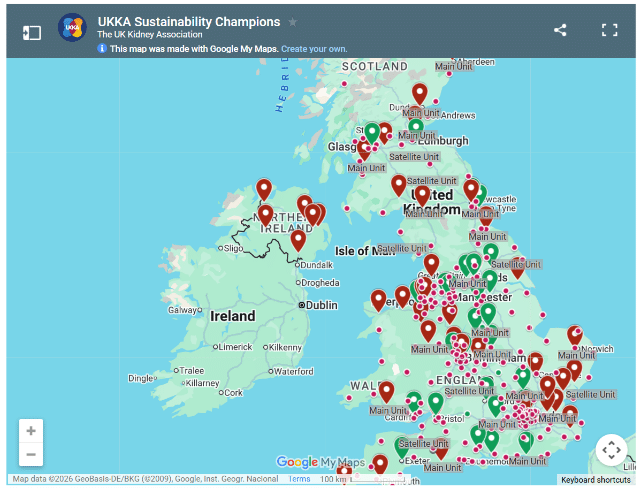
Concurrently, the launch of the national Kidney Centre Sustainability Champions scheme saw the recruitment and training of 60 champions across the UK. Champions complete the benchmarking survey and drive the adoption of sustainable best practice by leading their units to reduce carbon emissions, conserve resources, and share best practices across the UK, supported by the Sustainable Kidney Care Toolkit and a series of case studies.
A carbon modelling report was produced, demonstrating the potential impact of the sustainability interventions trialled on greenhouse gas emissions over the next two years. If the recommended interventions were rolled out across UK kidney centres under the assumed current adoption rate, 4,333 tonnes of CO2e emissions would be avoided – equivalent to the greenhouse gases emitted through building 135 new three-bedroom homes. A further 4,375 tonnes of CO2e could be saved over the next two years, if interventions are taken up at the rate modelled.
Phase two: Embedding best practice
Delivered in partnership with UKKA and supported by Medice and Fresenius, phase two will run from 2026, responding to the urgent need for continued development and capacity-building. This phase will develop the benchmarking tool in response to pilot data whilst advancing and expanding the kidney champion scheme. The carbon modelling report will be updated to account for new data, and a series of how-to-guides written in phase one will be piloted, reviewed, and updated.
Is your kidney centre championing sustainable care?
Check the Kidney Champion map above to see whether your unit has a champion and connect with them. If not, could you become a Kidney Champion and lead change for your unit, starting by completing the benchmarking survey?
Efficiency, equity, and emissions: Mapping the Living Kidney Donor Pathway Project
Kidney transplant recipients commonly wait around two years for a transplant, and the majority require dialysis three times per week during this time. Most dialysis units run six days a week, with busier units functioning at 98-99% capacity, meaning that increased wait times have both health and environmental consequences due to the carbon‑intensive nature of prolonged dialysis.
Approximately one-third of kidney transplants come from living donors. Living organ donation improves access to transplant and reduces wait times, especially for people of the global majority who wait approximately six months longer than white patients. Living kidney donation pathways are often inconsistent, with donors facing long assessment times and multiple appointments which can act as a deterrent and delay transplantation.
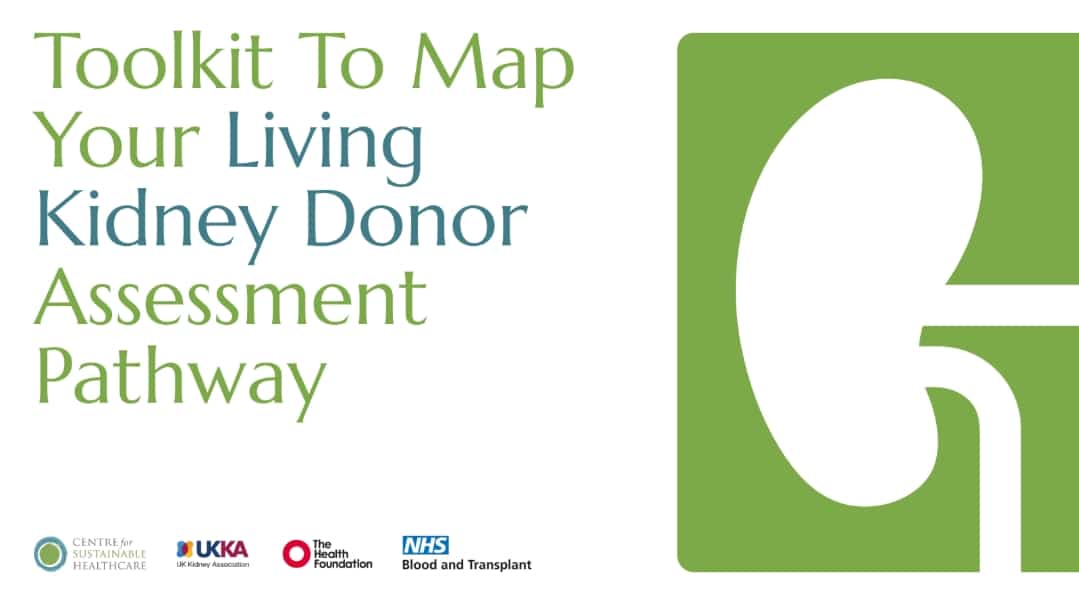
The Mapping the Living Kidney Donor (LKD) Pathway Project, supported by the Health Foundation and delivered with UKKA and NHS Blood and Transplant sought to better understand this pathway through mapping and evaluation. The project mapped the existing assessment pathway across diverse clinical settings, identifying variations and inequities, and calculated its average carbon footprint at 114 kgCO₂e (excluding surgery).
The project developed a freely available Living Kidney Donor toolkit and an Excel-based carbon calculator to support centres to review their pathway, both of which were shared through a series of online workshops. The project will continue to engage with living kidney donation centres through a regional system pilot which will explore barriers, enablers, and outcomes related to implementing change at a regional level.
European pilots and the four-Impact benchmark: The KitNewCare Project
KitNewCare is an EU co-funded project aiming to make the kidney care system significantly more environmentally sustainable. Its core aims include developing and implementing solutions capable of reducing healthcare emissions by at least 40% relative to 1990 levels, improving health outcomes, and lowering environmental, social, and financial impacts across the kidney care pathway. Read the scoping review below to find out about sustainability interventions in kidney care.
The project is grounded in a systematic decarbonisation approach that expands sustainability efforts beyond energy use to include new product pilots, clinical practice efficiency, prevention, and pathway redesign. CSH leads three KitNewCare work packages (WPs) which target elements across the system.
WP3: Workflow & Pathway Optimisations
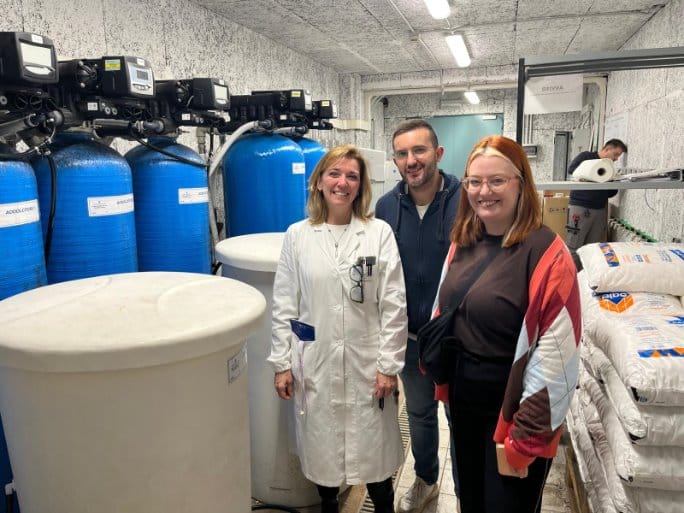
WP3 supports teams in KitNewCare’s four pilot sites (in the Netherlands, Poland, Italy and Spain) to implement and evaluate sustainable workflow and pathway changes using improvement methodologies. A blog series on CSH’s networks captures insights into WP3’s visits to the Modena and Warsaw sites, and the European Kidney Patients Federation Patient Summit in 2025.
“The team has been leading ongoing work within the nephrology department around waste, auditing current practices, observing day-to-day workflows, and holding meetings with the nurses to identify where meaningful changes can be made. Their commitment to understanding the root causes of waste and their collaborative approach was clear throughout our discussions.”
– Hattie Attwell-Rogers on visiting the Modena pilot site

WP6: Communication, dissemination & exploitation
A free-to-access online course on Sustainable Kidney Care has been developed to support healthcare professionals to deliver excellent care whilst also understanding and reducing the environmental impact of their work. The courses are available in English, German, Italian, Spanish and Polish.
This work package is also developing and fostering a community of practice through CSH’s Kidney Care Sustainability Network. Through the network, members can share reflections, ask questions, and signpost to resources and events. The Kidney Care Sustainability Network hosts monthly events disseminating learning and best practice around sustainable kidney care. Join the network to stay up to date with events and KitNewCare project outputs.
WP5: Development of a benchmarking tool & dashboard
CSH has worked closely with consortium partners 040 and Trinity College Dublin to develop a benchmarking tool and dashboard. This online tool is designed to measure and monitor health outcomes, social impacts, environmental impacts, and costs across kidney centres and their different treatment options. With the project’s software developers, CSH has built both the tool and its interface. The tool will be piloted in 2026 with clinical partners and additional kidney centres across Europe.
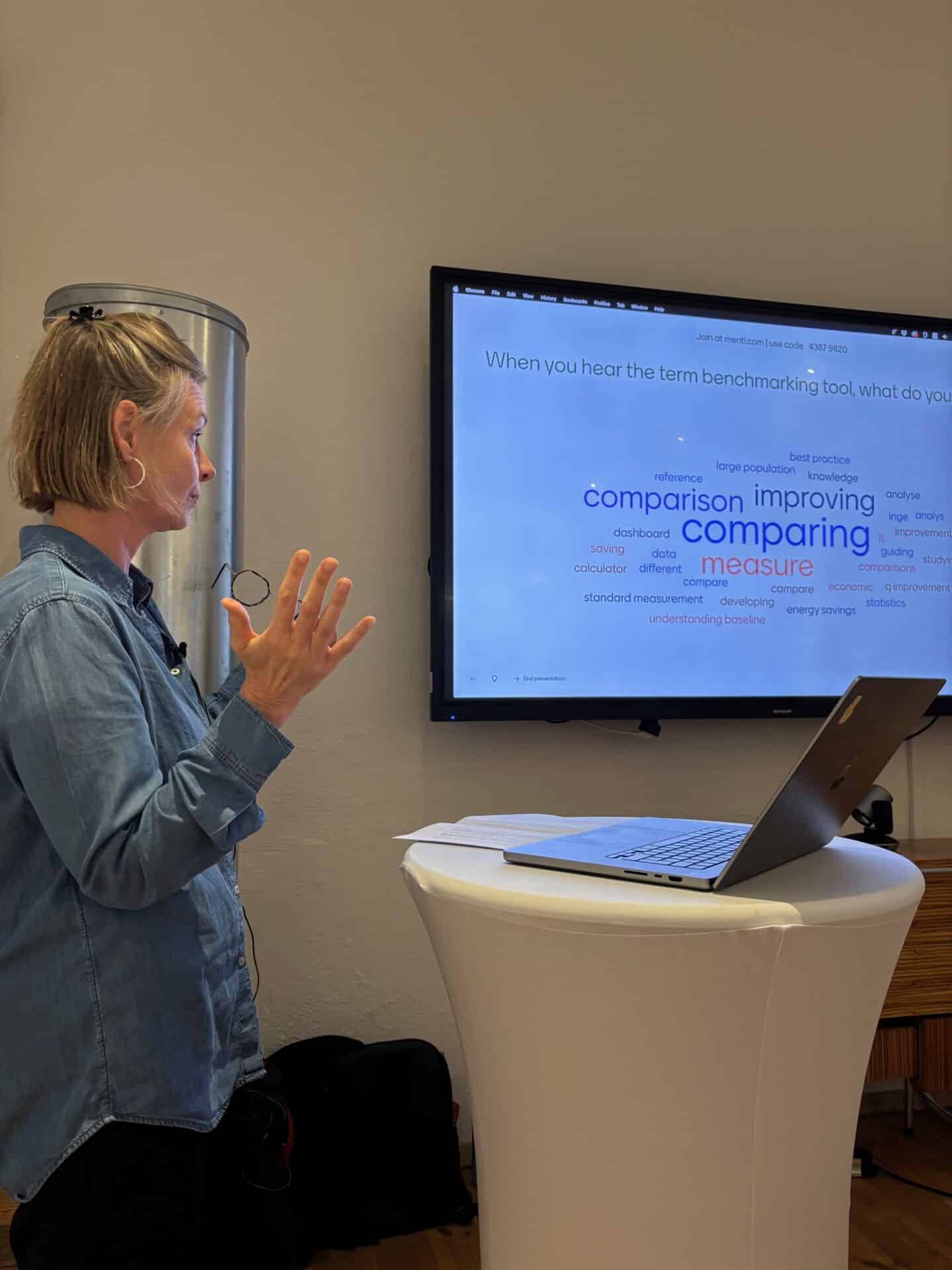
The benchmarking tool was introduced at the Nordic Conference on Sustainable Healthcare in Malmö, Sweden, where participants learned about key performance indicators, content, technical structure, and its functionality.


“While tools already exist to measure the environmental footprint of kidney centres, the KitNewCare benchmarking tool offers a more holistic approach by integrating environmental impacts with health outcomes, social impacts, and costs. This aligns with the sustainable value framework for healthcare, which considers patient and population outcomes across the ‘triple bottom line’ of environmental, social, and economic impacts.”
– Aycan Yasar (EU Horizon Project Manager, WP5) & Ingeborg Steinbach (CSH Analytics Director & Work Package Lead)
Could your kidney centre be part of this international project?
KitNewCare is recruiting associate pilot sites to support the testing and application of selected tools and approaches. Applications are open to kidney care centres, dialysis units and hospitals across Europe that are interested in improving the sustainability of kidney care services.
A systematic, scalable approach to decarbonising kidney care
These projects show how kidney care can be systematically decarbonised without compromising quality by building shared standards and data, redesigning pathways for equity and efficiency, and piloting and scaling effective solutions.
Everyone in kidney care can take action, whether it’s accessing learning resources to develop your knowledge of sustainable healthcare, utilising the benchmarking tools to support collective understanding and improvement, or becoming a champion to lead change at your centre.