‹ Go back
Sustainability and the Renal Technologist: ART Annual Conference 2026 Blog
5 November 2026
The Association of Renal Technologists (ART) Annual Conference took place at Belton Woods, Grantham, on 8 and 9 October 2026. It brought together renal technologists from across the UK, many of them in management roles, alongside industry partners. The Centre for Sustainable Healthcare was invited to deliver a workshop, “NHS Net Zero Healthcare: How can a Renal Technologist help?”, as part of the capacity building work of KitNewCare. KitNewCare is a Horizon Europe co-funded project that aims to make the kidney care pathway more sustainable.
Kidney care is one of the most resource intensive areas of healthcare. Only 0.1 to 0.2% of the population receive kidney replacement therapy, yet this group accounts for between 2% and 6% of healthcare budgets. Around two thirds of the emissions from kidney care come from dialysis. A single haemodialysis session uses about 16 kWh of energy and 400 litres of water and produces 1.5 kg of waste, and patients typically have around 150 sessions a year. Many of these impacts fall within the domain of renal technologists, including water treatment, energy, disinfection, consumables and waste, so small changes in technical practice, repeated across every session, add up to a significant difference.
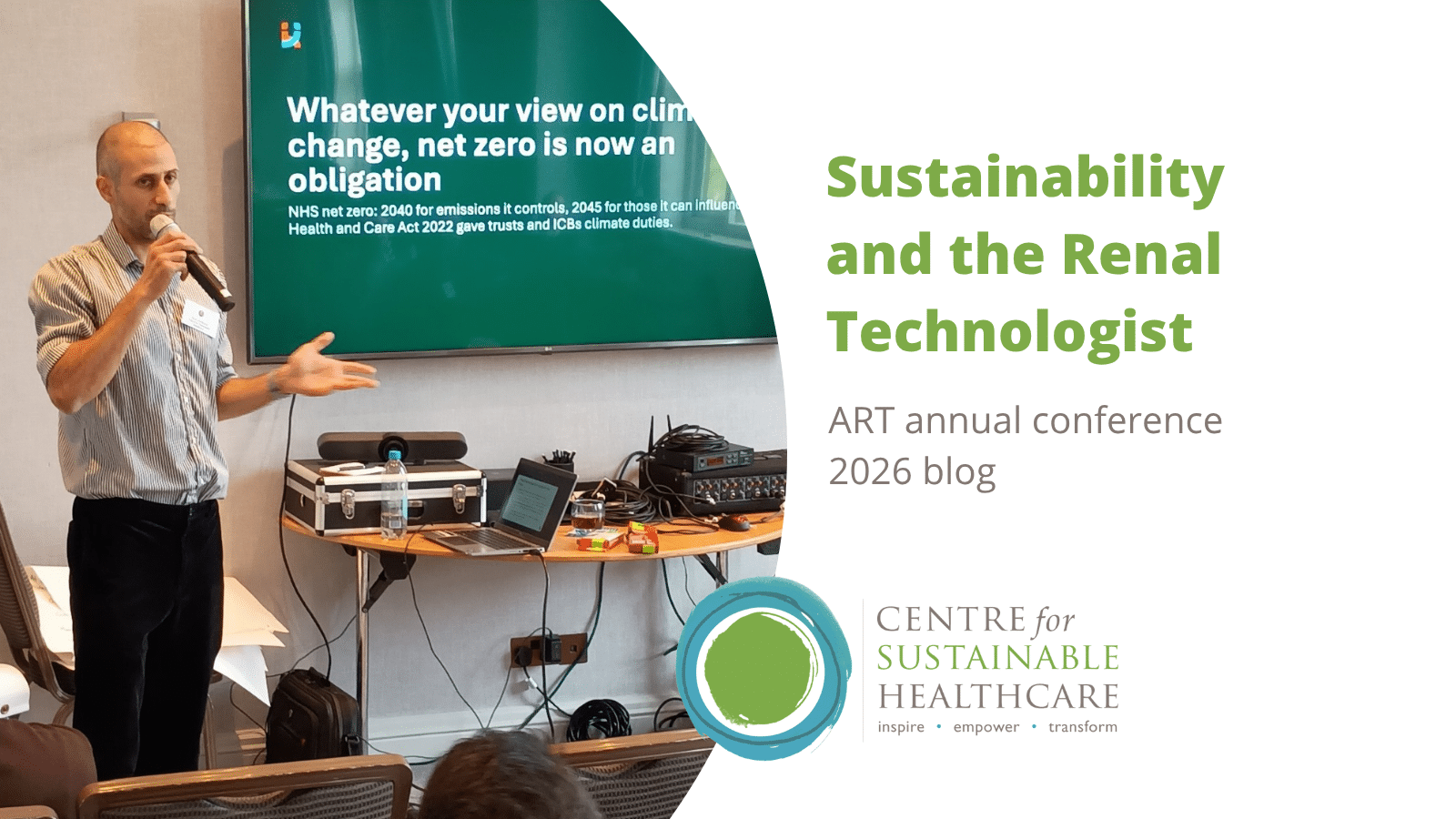
The workshop started from a simple premise; whatever your view on climate change, net zero is now an obligation. The NHS has committed to net zero by 2040 for the emissions it controls and by 2045 for those it can influence, and the Health and Care Act 2022 placed climate duties on trusts and integrated care boards. The renal technologists in the room are the experts who can turn commitments into practice, for one of the most resource intensive specialities.
The aim is simple: by integrating sustainability into the ART Training Scheme, the next generation of renal technologists will enter practice already looking through a sustainability lens, and will carry that thinking with them as they progress into management roles.
“The renal technologists in the room are the experts who can turn commitments into practice”
Around 35 delegates took part in the workshop, using live polling to rate a set of draft sustainability learning outcomes for the ART Training Scheme. The outcomes covered five areas: the water treatment plant, consumable evaluation, asset management, water plant maintenance and disinfection, and professional standards. Delegates then discussed what would help or hinder these outcomes in practice and what might be missing. Discussion was lively and grounded in day-to-day experience, and the responses will now be analysed in full.
Above all, the session marked a beginning. An expert panel of renal technologists formed at the event to take this work forward, as the first stage of a Delphi consensus process to integrate sustainability into the renal technologist curriculum. This matters beyond the UK. As far as we are aware, the ART Training Scheme is unique as a dedicated curriculum for renal technologists, which gives the UK a real opportunity to set an international precedent for how this workforce is trained to deliver more sustainable kidney care.
Industry partners were well represented across the two days, with manufacturers and suppliers exhibiting the latest dialysis and water treatment technology. Several stands highlighted sustainability features such as adjustable dialysate flow and optimised disinfection times, a welcome sign that environmental impact is becoming part of the conversation about equipment.
A highlight of the conference was the ART museum. Its historic dialysis machines included an artificial kidney built in the Guy’s Hospital medical school workshop in 1962. It was a striking reminder of how far renal technology has come.
Renal Technologists are the unsung heroes of the kidney care pathway. From calibrating and repairing machines to keeping dialysis water safe and visiting patients at home to keep their equipment running, they work behind the scenes to make sure every treatment can go ahead safely. That same expertise puts them at the heart of more sustainable kidney care.
Thank you to ART for the invitation and to everyone who took part. Watch this space for findings as the Delphi process gets underway. To keep up with developments, join the Kidney Care Sustainability Network.
Author: Dr Furat Al-Murani, Clinical Delivery Lead: Capacity Building in Sustainable Kidney Care